Monday, May 20, 2013

Masaccio,Expulsion of Adam and Eve from Eden, Florence,Italy,ca.1424–1427.Fresco, two dimensions

 
Masaccio was an Italian artist who specialized in frescos, perspective, and lighting. Masaccio was presumably trained by Masolino da Panicale, but Masaccio differed from most artists because he did not follow the exact style as his master. He changed his style sharply once he began painting on his own. Surprisingly, despite Masaccio's fame and recognition in the art world, he only spent six years of his life painting before dying. Masaccio painted this work in narrow space in the entrance of Brancacci Chapel in Florence, Italy. It shows a banished and ashamed Adam and Eve being cast away from their beautiful Eden. The two are not being forced out of Eden, but instead, they are stumbling blindly away from it.
Death isn't always physical; sometimes, it can be spiritual. This painting shows the death of Adam and Eve's purity as they are being banished from Eden. This instance is an excellent example of death, it exposes its fit into this exhibit. Also, Masaccio was sick while painting this and died up to a year after completing it at the extremely young age of twenty-seven. This reality is proof that death does not wait for life. Often times, death is unexpected and unexplainable. The painting's and painters story make this piece a perfect fit into this exhibit.

Francisco Goya, Saturn Devouring One of His Children, 1819–1823.Detached fresco mounted on canvas, two dimensions


Francisco José de Goya y Lucientes is a notable Spanish artist. In Goya's early years as an artist he painted religious and royal family portraits. These are the types of paintings one would expect from a career-artist of Goya's time. However, when Goya got into his later years and was inflicted by some sickness or poisoning which scholars are still unsure of, he began painting his dark series. The entire dark series was painted on the walls of his farmhouse. He was not commissioned or working by anyone else's terms, so these paintings were completely his own expression. Goya painted Saturn (the Greek god of carnage) Devouring One of His Children on the walls of his private farmhouse. This death inspired painting is one of the most recognizable of his dark series.
This painting was designed while Goya's health was declining and he was approaching an inevitable death. With his intimacy with death, Goya's understanding of it was enhanced. Through this work, he expresses the value of human life compared to a God's. The lack human life's value is not true only when compared against gods but also when humans are considered by themselves. Life isn't of high value; life is taken for several reasons on a day to day basis whether it be by murder, age, or illness. Death is a common occurrence, and this image reminds the audience of that reality.

Martin Schongauer,Saint Anthony Tormented by Demons,ca.1480–1490.Metal Engraving. three dimensions

 
Martin Schongaur was a German artist who was considered one of the first masters of engraving. Engraving was an evolved form of woodcut which is a form of relief sculpture that designs a two dimensional image with texture and depth. Engraving is the same concept, but it's done on metal instead of wood. After engraving the piece, ink is used to fill in the engraved areas, so there is color to help define forms. This is the technique Martin used to design this piece. By designing this image which transitioned effortlessly from smooth skin to rough feathers, and exceptional textures on the demons, Martin expressed his expertise in the field.
When the first automobiles hit the market, other forms of transportation began to die. When cell phones came out, pagers died. Prior to this piece, most artists only did wood engravings, and metal engraving was a new technique. Thus, this piece represents the death of an old technique. Also, the demons tearing and ripping at the saint are essentially trying to kill him, and this is a reminder of the struggle of life. Ultimately, life's aim is to kill. The only destination in life is death. For these two reasons, this work has a clear relation to the subject of this exhibition.

Henry Fuseli,The Nightmare,1781.Oil on canvas, two dimensions

 
Henry was born in Switzerland, but as he went through life, he moved to England and settled there.  He was primarily self-taught, and he eventually became a member and instructor at the Royal Academy in England. Most of his works were an expression of his endless imagination and focused on horror, dark fantasies, and the sadistic as is the case in The Nightmare. In this piece, a limp woman is preyed on by an incubus which in medieval times were considered demons who made sexual prey of women. Fuseli is often times accredited with being one of the first artists to translate and replicate the dark side of the human subconscious.
This painting is a clear fit for this exhibit. The woman is pacified or seduced by evil macabre. This state of consciousness, or lack thereof, is a cousin to death. In fact, were it not for her heart beating and lungs breathing she would be dead. However, this statement could be said about any living entity, but the difference is that this woman is not conscious since she is completely subdued. This work is intended to remind the audience how close sleep, or any other state with little to no consciousness, is to death. Perhaps death is like falling asleep, and everyday people wake up only to dream.

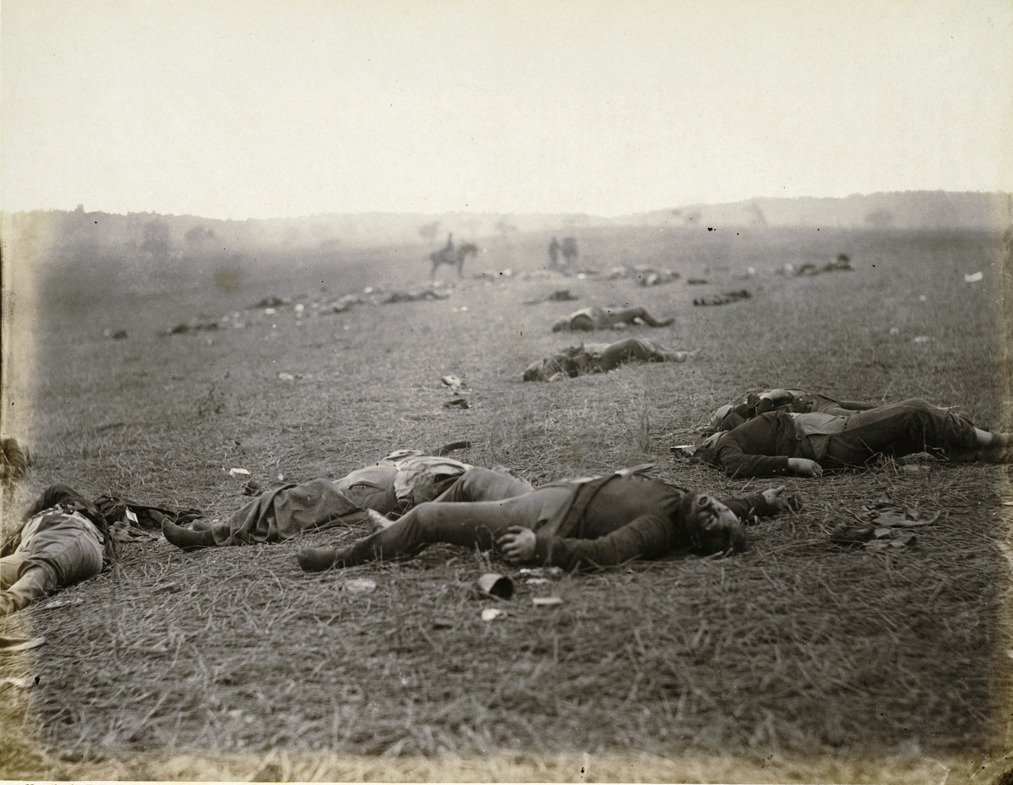
Timothy O’Sullivan, "A Harvest of Death," Gettysburg, Pennsylvania, July 1863, 1863. Albumen print by by Alexander Gardner, two dimensions


Timothy O'Sullivan was an American photographer who took several images and documentations of the American Civil War. This piece expresses the power of photography. Prior to this medium, an artist could spend days painting, sketching, or sculpting an idea or moment in history, but during this process, the artist translates what he sees and unintentionally includes his or her emotions and feelings into that translation. With photography, an artist can instantly capture physical forms as they were by using an emotionless mechanical device rather than the human mind. This image shows corpses as far as the horizon which transform death into an objective and simple subject. There is no attachment or tragedy related to this image, for it is simply a picture of death as it is. Also, this image shows the low value of human life during times of war.

This final piece of artwork needs no explanation to the relationship it has with death. The mass of bodies shows how easily and quickly something can go from living to dead. There is no emotional attachment or sadness that accompanies these bodies. The image is simple, and it shows death in a simple manner. When these people died, they merely fell to the ground and laid there until their corpses were collected and disposed of. So, this image has a raw and uncut interpretation of death.

Conclusion

The process of designing an online gallery and exhibit is a delightful experience. Completing this task is not as simple as picking the first ten images one can think of and writing a lack-luster response. As the curator, a person has to think deeply about how all images connect and flow together, and one must draw powerful connections between each piece. For example, I started with an image that wasn't necessarily related to death because the image was primarily concerned with life, but I chose that image to make the audience realize that death is the opposite of life. Life and death go hand and hand, and they are dependent on each other. By doing this, I enhanced the audiences understanding and set them up for the following nine images. For me, the whole process came naturally. I have a relatively easy time choosing images, organizing images, and making connections to a common subject. However, acquiring background information and understanding the history of works is a harder task for me. This reality is likely due to the fact that I am not an avid historian, but I am an avid artist and designer. Overall, being a curator is an interesting occupation. I enjoy the process of organizing and connecting the works. As an intended art major, this is a process I would undoubtedly adore doing again.